

It's the first and the most frequently asked question we hear when someone reaches out to my practice. And honestly, it's one of the harder ones to answer, not because the numbers are secret, but because the question itself is more complicated than most people realize when they first ask it.
Here's the truth: when two surgeons both call their procedure a "deep plane facelift," they are not necessarily describing the same operation. The term has become so widely used and abused in plastic surgery especially with social media marketing that it now covers an enormous range of procedures, different levels of complexity, different surgical duration, different anatomical approaches, and very different outcomes. If you are comparing surgery costs like purchasing items, it is like comparing the cost of Toyota Camry vs. a Rolls Royce, both are great cars, both get you from point A to B, and both have four wheels.
So let me try to give you a real answer.
Across the United States, a deep plane facelift with neck lift by itself, not including eyelid lift, brow lift, fat grafting or other ancillary procedures typically runs somewhere between $20,000 and well over $100,000. That range exists because the variables are significant, the surgeon's experience and reputation, where the practice is located, the anesthesia approach, the facility, and the actual complexity of what's being done. In my practice it starts around $65,000 but it includes a lot of perks that also come with it. You need to continue reading this to the end to find out that you are not just getting a facelift, but also an incredible experience and service of a lifetime.
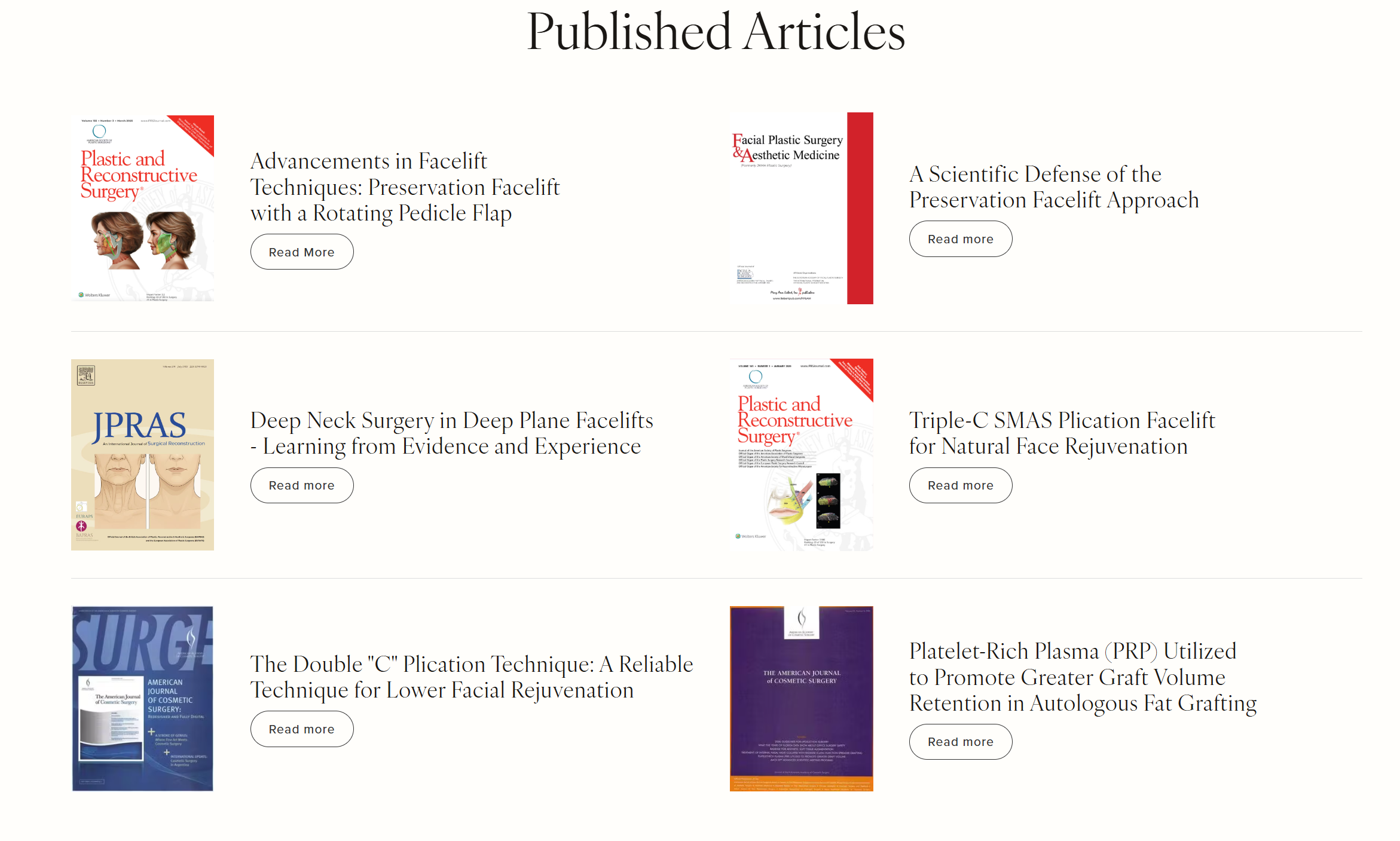
In my practice, the investment reflects something specific. It reflects more than two decades of experience, over 5,000 facelift surgeries, a technique I developed and published in peer-reviewed literature, and a level of specialization where facial rejuvenation isn't one of many surgeries I do: it is the only thing I have been doing for the past two decades. That distinction matters more than most patients initially expect.
This is what I would like you to think:
When you start comparing quotes, the instinct is usually to look at the number and try to make sense of it. I'd encourage a different approach. Instead of asking how much it costs, ask yourself what I am getting for my investment.
Is this a surgeon who performs a handful of facelifts a year alongside a full menu of other body procedures? Or is the surgeon’s practice built almost entirely around facial rejuvenation, and they have spent years studying anatomy, refining technique, publishing research, and teaching other surgeons internationally? Like choosing a primary care physician, knowing a little about many things treating your irregular heart rhythm known as Afib vs. an electrocardiologist knowing a lot about one thing, how the electrical system of the heart works.
After that you need to figure out if the procedure you’re getting is a true deep plane facelift, not just an imitation. Is your face in the hands of a surgeon who has evolved continuously through thousands of real cases, honest assessment of outcomes, and a genuine commitment to doing it better? Or just a surgeon watching education recorded videos, attending a couple of courses then trying to experiment on your face.
These are genuine questions you should ask yourself. These are the factors that separate an ordinary facelift result from an excellent result that will bring compliments from others on your youthful appearance and more importantly you'll still love the results decades later.
Why I Developed the Preservation Deep Plane Facelift Approach?
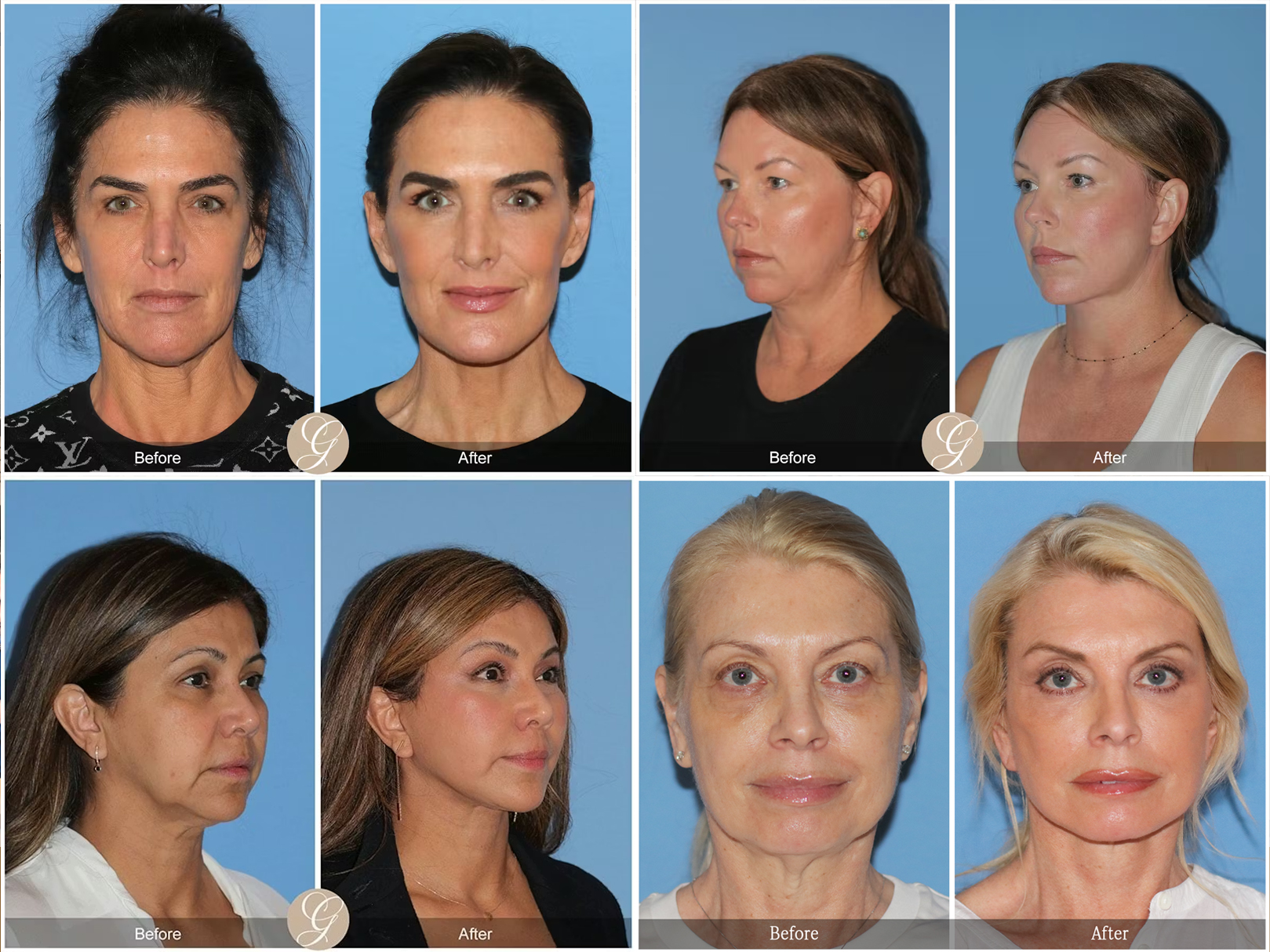
Early in my career, I performed traditional facelift techniques alongside my peers. And while the results were often good, I kept noticing limitations I couldn't ignore. Some techniques relied too heavily on skin tension creating that pulled, tight appearance that announces itself immediately. Others produced prolonged swelling or didn't address the neck and jawline with the precision I felt my patients desired. So, I went back to the anatomy. Studied it. I questioned it. And eventually developed Preservation Lift™ which is widely known as the Preservation Deep Plane Facelift; a technique built around a fundamentally different philosophy. Rather than pulling the superficial tissue tighter, it focuses on deeper layers. By repositioning a deep structure called mobile SMAS, a tissue made of fascia, muscles and fat which is the scaffold for the soft tissue of the face. As we age, we lose collagen and elastin which are the basic framework of SMAS tissue. Then gravity pulls the loose SMAS down, causing midface deflation, jowl formation, and neck laxity with the band to appear. A youthful face will turn into a tired and sad looking face.. So by releasing the retaining ligaments that are holding this loose mobile SMAS , then reanchoring the mobile SMAS to the original position of decades ago, meanwhile protecting natural facial movement and structures, minimizing unnecessary trauma and skin undermining working on this deeper layer throughout by keep healthy blood supply to the tissue.
The result is a face that heals faster, swells less, and looks natural, not because I avoided doing enough, but because I did the right things lifting the tissue that has the issue: the mobile SMAS, not just pulling on the skin..
I was the first to publish a comparative analysis of a preservation deep plane facelift against traditional deep plane facelifting in the Plastic and Reconstructive Surgery Journal with the help of medical researchers from the Harvard and Cedar Siani medical centers. I've presented these findings in national and international plastic surgery conferences around the world alongside some of the most respected names in the facial plastic surgery community. Other surgeons around the world have adopted it into their own practices. Now, preservation facelift is becoming a common name amongst facelift surgeons.
I mention that not to impress, but to give context. When you're evaluating what a procedure costs, knowing whether the technique has been performed thousands of times, validated, published, and taught internationally is part of what you're paying for.
The Most Expensive Facelift Is Often the One That Gets Redone!
I've seen it more times than I can count. patients having had a poorly performed facelift elsewhere by trying to save money or not doing enough research and going to the same surgeon who performed their breast surgery. But a year later, they’re sitting across from me with recurrence of jowls or neck laxity, and even worse scenarios like incisional scars, pulled earlobes, or a look that feels tight with unnatural smiles, eyes resembling a mask, or unusual facial movements that easily grab attention.
Not long ago, a woman in her early sixties came to see me for consultation and was concerned about the cost. She decided to have surgery with an inexperienced surgeon at a much lower price, upon returning six months later, she was quite unhappy with how things had settled in a short period of time. I needed to perform a revisional preservation deep plane facelift and a structural neck rejuvenation to correct her anatomical facial positioning. Her recovery was smooth. And more importantly she looked like her younger self. Refreshed, rested, natural facial movement, no strange line on face and her eyes looking brilliant again. Now when you add up the cost, she spent more in total than she would have if she had done thorough research and put more thought into surgeon experience, surgical technique and long term results the first time around.
That's not a sales pitch. It's just a pattern I've watched play out enough times in my 20 years of performing facelift surgery.
What Do You Need to Know Comparing Surgeons for Your Deep Plane Facelift Surgery?
If you're in the process of researching and comparing options, here's what I'd encourage you to look at beyond the price tag:
How many facelifts has this surgeon actually performed in his career? Is facial rejuvenation the center of his/her practice or one of fifty other surgeries they offer? What do their deep plane facelift before and after photos look like over time, not just at six weeks? Are they using standard photography, or just before surgery photos without makeup and after photos are selfies with glam or heavily doctored photos? What is their revision rate? How do they approach anesthesia and recovery? Is the facility accredited? And perhaps most importantly, do the results look dramatically natural, or do they look like they had drastic surgical results?
In my practice, I perform my facial rejuvenation procedures at my state-of-the-art accredited surgical center within my luxurious medical facility in Newport Beach California. My choice of anesthesia is twilight sedation known as IV sedation with propofol, rather than general anesthesia requiring intubation. Twilight sedation reduces physiologic stress on the body, minimizes post operative nausea, blood clot formation, or memory loss. What you’re paying for your facial rejuvenation is not simply covering the surgeon fee, anesthesia and facility fees. You also get a white glove service! unlimited office visits, a luxury private recovery room with your own nurse to monitor your post op recovery. Several sessions of advanced photobiomodulation therapies to reduce swelling and bruising. Hyperbaric oxygen treatments to expedite your healing process, nutritional optimization needed for recovery, and IV vitamin therapies to ensure a rapid recovery. The goal is not just a beautiful result, but also a healing experience that matches the quality of the outcome. Think of it like going to a luxury resort and not having to make decisions about day-to-day things while getting the best service.
So, What's the Bottom Line? The best facelift is not the cheapest one. But it is also not the most expensive one either.
It's the one performed by a surgeon who has dedicated their career to understanding the face at every level anatomically, aesthetically, and humanly with artistic eyes fine-tuned for details. One whose results still look natural years later. One who treats your face not as a procedure to complete, but like a priceless piece of sculptor, something worth protecting.
Remember, you're not purchasing an operation like an item, you’re putting your most precious face in the hands of a surgeon who will bring value to your life. You're investing in someone's judgment, their training, their trained hands and eyes, their experience, and their ability to look at your face and understand what it needs, and what it doesn't.
The best result, in my opinion, is always the same one: you look refreshed, rested, and confident. And nobody can quite put their finger on why. Value beats pricing at every level.